
Lake Erie clay country
Hydroseeding in Cleveland, OH
New lawns, steep banks and construction sites seeded for heavy soil, wet springs and a short fall window.
- No charge to walk your property, and every quote comes in writing
- Itemized pricing: prep, topsoil, seed mix and erosion control listed separately
- A printed watering and first-mow sheet left on every new lawn
Growing Grass on Cleveland Ground
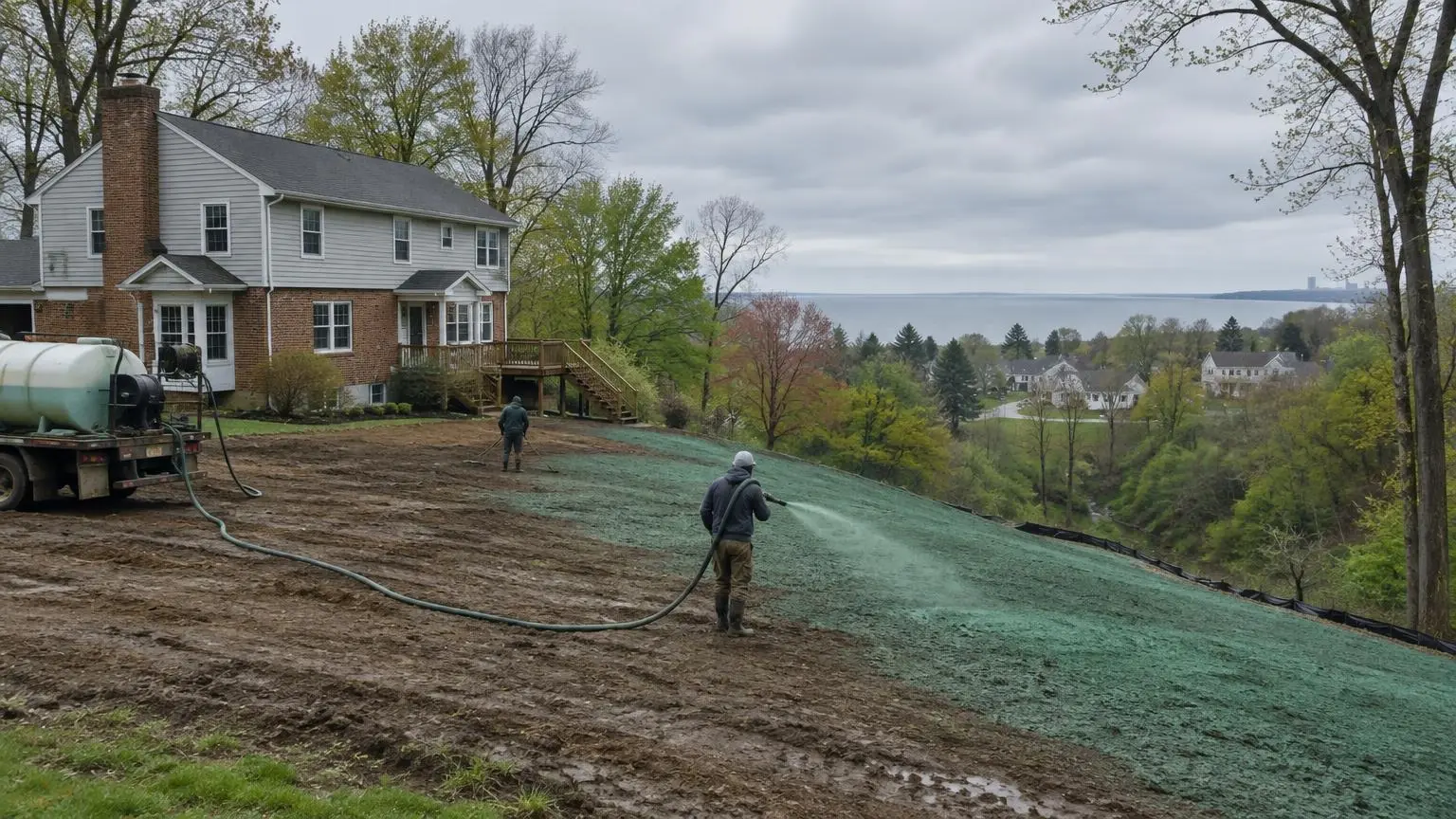
Hydroseeding in Cleveland is a one-pass way to start grass: a tank mix of seed, wood or paper fiber mulch, fertilizer, tackifier and water is sprayed over prepared soil, and that wet layer anchors the seed and holds moisture around it until it germinates. We use it for new lawns behind fresh construction, for yards torn up by drainage or sewer work, for ravine edges and road banks, and for builder lots that need cover before an inspector will sign off. It is the method most hydroseeding companies around Northeast Ohio lean on for anything bigger than a patch, because one pass covers ground quickly and the mulch layer stays put in a way loose straw does not.
What the soil is doing under your lawn
A lot of the upland ground in this part of Ohio is glacial till. The USDA's official description of the Mahoning series, which covers more than 450,000 acres of Northeastern Ohio and northwestern Pennsylvania, calls it very deep, somewhat poorly drained soil formed in till that came mostly from shale and siltstone. The top 7 inches or so is a dark grayish-brown silt loam. Below that the subsoil turns to firm silty clay, and water moves through it slowly. In most years a perched water table sits 6 to 12 inches below the surface from October through June. Its neighbors on the same hillsides, the Ellsworth, Trumbull and Miner soils, run from moderately well drained to very poorly drained depending on where they sit on the slope.
For a new lawn that means two things. Seed laid on bare subsoil left behind by an excavator struggles, because the clay crusts in sun and stays soggy after rain. And water that cannot soak in runs off, taking seed with it. Good topsoil and a grade that sheds water away from the house matter more here than the seed brand.
Bluffs, ravines and runoff
Cleveland sits on a series of irregular bluffs that run roughly parallel to the lake, cut mainly by the Cuyahoga River, Big Creek and Euclid Creek. The land climbs from 569 feet at the Lake Erie shore to about 650 feet at Public Square, less than a mile inland, and 791 feet at Hopkins Airport. Suburbs to the south and east are full of creek valleys and wooded ravines. When a yard backs onto one of those slopes, a light lawn spray is not enough. Banks steeper than a gentle lawn grade get a heavier bonded mulch or an erosion control blanket pinned to the soil, and sometimes a silt fence run across the bottom of the bank that stays until the new turf is rooted.
Weather that sets the calendar
NOAA's 1991 to 2020 normals for Hopkins Airport put average yearly precipitation at 41.03 inches, spread fairly evenly: every month from April through October averages between about 3.6 and 3.9 inches. That steady rain helps new seed, but it also means soft ground and washouts on bare soil in spring. Average snowfall is 63.8 inches, and lake-effect snow typically runs from about mid-November until the lake surface freezes in late January or early February, heaviest on the East Side and in the Heights. Daytime highs average about 60 degrees in April, 71 in May, 76 in September and 64 in October.
Cleveland lawns are cool-season grass: blends of Kentucky bluegrass, perennial ryegrass and tall or fine fescue. Those grasses root best when days are warm, nights are cool and weeds are slowing down. Extension services in other cool-season states point to late summer: Iowa State calls mid-August to mid-September the best time to start a lawn from seed. Here, that late-summer and early-fall window is our first choice, with spring from about mid-April through May as the second. A lawn sprayed in late spring has to get through July heat young, so it needs more watering.
Hydroseed, sod or dry seed?
There is no single right answer, and we will tell you which one fits your yard.
- Sod looks like a lawn as soon as the last roll is laid, and it can take foot traffic sooner. It costs far more: HomeGuide lists sod installation in a range of $1 to $4 for every square foot covered. On wet clay, sod laid over a poor base can stay spongy and shallow-rooted.
- Dry seed with straw is the cheapest and works on small, flat areas. Seed sits on top of the soil, birds find it, and a hard rain on a slope can move it into the street.
- Hydroseed sits in between on price. According to the University of Nebraska Extension, it runs slightly above dry seeding and usually below sod. The mulch keeps moisture at the seed, and in decent weather the first sprouts often appear within 5 to 7 days. The tackifier holds the mix on slopes that would shed dry seed.
For most new construction lots and large renovations around Cleveland, hydroseed gives the best balance of cost and coverage. For a narrow strip by a front walk that needs to look finished next week, sod may be smarter.
Stormwater rules on construction sites
Ohio EPA's Construction Stormwater General Permit, OHC000006, covers construction that disturbs one or more acres. It took effect on April 23, 2023, runs through April 22, 2028, and requires the site to have a stormwater pollution prevention plan (SWPPP) in place ahead of any earthwork. Many local cities add their own rules for smaller sites. Euclid's erosion and sediment control chapter, for example, provides for an abbreviated plan on sites disturbing one-tenth of an acre to one acre, and describes a pre-winter stabilization meeting held before October 1 to plan winter controls. It names seeding and mulching as stabilization practices. That is why builders call hydroseeding contractors in late September: bare dirt going into a Cleveland winter is a liability.
What a hydroseeding job looks like
We start by walking the property, checking the grade, the topsoil and where water runs. Then we fix what needs fixing: rough grading, rock and debris removal, fresh topsoil where the old layer is gone, and a fine grade to smooth it. The seed mix is chosen for sun, shade and use. On spray day the slurry goes on in overlapping passes until the ground is evenly green. You get written watering instructions, because the first three weeks decide whether the lawn takes. Most new lawns are ready for a first mow in four to six weeks.
Where the rest of our work fits
The same truck and crew handle erosion control on slopes and ditches, silt fence and inlet protection for permits, grading and topsoil for new yards, and overseeding and lawn repair for thin turf. Each has its own page below, with the costs we can document and the questions people ask most.
Cleveland Neighborhoods and the Towns Around Them
We work throughout Cleveland and across Cuyahoga, Lake, Lorain, Geauga, Medina and Summit county towns. To the west, Bay Village, Avon Lake, Avon, North Ridgeville and Olmsted Falls run from lakefront lots to North Ridgeville, described as the fastest-growing city in northern Ohio. South of the city, Parma, Independence, North Royalton, Brecksville, Strongsville, Brunswick, Medina and Hinckley Township climb onto higher, hillier ground with Rocky River and Cuyahoga Valley ravines. East and southeast, Euclid, Willoughby, Mentor, Solon, Chagrin Falls, Aurora, Twinsburg, Hudson and Chardon range from old lake beaches to the heavy snowbelt ridges. Pick a town below for its soil, slopes and drainage notes.
- Hydroseeding in Cleveland, OH
- Hydroseeding in Strongsville, OH
- Hydroseeding in North Royalton, OH
- Hydroseeding in Brecksville, OH
- Hydroseeding in Avon, OH
- Hydroseeding in Avon Lake, OH
- Hydroseeding in North Ridgeville, OH
- Hydroseeding in Solon, OH
- Hydroseeding in Medina, OH
- Hydroseeding in Brunswick, OH
- Hydroseeding in Hudson, OH
- Hydroseeding in Twinsburg, OH
- Hydroseeding in Mentor, OH
- Hydroseeding in Aurora, OH
- Hydroseeding in Parma, OH
- Hydroseeding in Olmsted Falls, OH
- Hydroseeding in Chagrin Falls, OH
- Hydroseeding in Chardon, OH
- Hydroseeding in Willoughby, OH
- Hydroseeding in Independence, OH
- Hydroseeding in Bay Village, OH
- Hydroseeding in Euclid, OH
- Hydroseeding in Hinckley Township, OH
Our Services
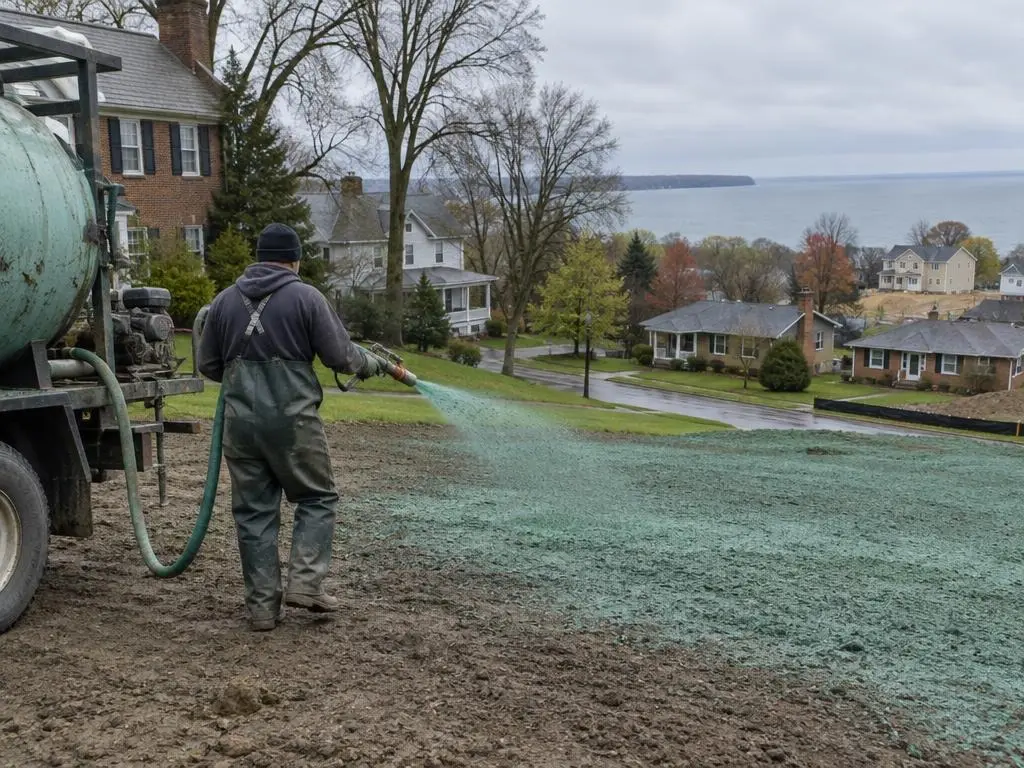
What we handle on Cleveland lawns, ravine banks and construction lots, from bare dirt to established grass.
Hydroseed Lawn Installation
New lawns sprayed on prepared topsoil for new homes, renovations and torn-up yards.
Learn more →Commercial & Builder Hydroseeding
Large-area seeding for home builders, site contractors, schools, parks and commercial lots.
Learn more →Slope & Ravine Erosion Control
Holding Cleveland banks, swales and ravine edges with hydromulch, bonded fiber matrix or erosion control blankets.
Learn more →Silt Fence & Sediment Barriers
Silt fence installation, catch-basin inlet protection and other sediment control for permitted Cleveland job sites.
Learn more →Grading, Topsoil & Dirt Work
Yard grading, topsoil, fine grading and drainage dirt work before seeding.
Learn more →Lawn Renovation & Overseeding
Lawn repair, overseeding and renovation for thin, patchy or damaged Cleveland lawns.
Learn more →Common Questions
Roughly what does it cost to hydroseed a yard around Cleveland?
For residential hydroseeding, published national guides put the price somewhere between $0.07 and $0.35 per sq ft, depending on which guide you read; HomeGuide's example of a 5,000 square foot lawn comes to $1,000 to $1,750. Expect a minimum charge on small jobs too: HomeGuide lists $300 to $500 or more. Grading, topsoil and slopes are usually the bigger variables in Cleveland, so we quote once we have seen and measured the yard.
Which month is the best to hydroseed a lawn in Cleveland?
Late August and September are our first choice for cool-season grass here: warm soil, cooler nights and fewer weeds. Mid-April through May is the second window. A lawn sprayed in June can work but needs steady watering through July.
Is there a downside to hydroseeding?
You do not get an instant lawn the way sod gives you one; expect sprouts in about a week and a first mow in four to six weeks. It needs regular watering for the first few weeks. And on bare clay subsoil it will struggle like any seed, so prep matters.
Can I hydroseed my lawn myself?
Small hand-held kits exist, but a professional machine mixes seed, mulch and tackifier evenly and sprays it at a steady rate. For a whole yard or a slope, most of the result comes from grading and topsoil, which is the heavy part of the job anyway.
Will hydroseed wash away in a Cleveland downpour?
The fiber mulch and tackifier bind to the soil and hold seed through ordinary rain once dry. A severe storm on a steep bank can still cut channels, which is why slopes get heavier mulch or blankets and why we grade so water does not concentrate.
How often do I water new hydroseed?
For roughly the first three weeks, sprinkle lightly several times a day so the mulch stays damp without water running off. Iowa State Extension notes hot, windy days may need up to four light waterings. After the grass is up we taper to deeper, less frequent watering.
Can you hydroseed in October or November?
Early October can still work for erosion cover, but grass started that late often does not root well before lake-effect snow and frozen ground. For a lawn we usually recommend waiting for spring and putting down temporary stabilization if the dirt cannot sit bare.
Why Homeowners Call Hydroseeding Cleveland
Soil first, seed second
On heavy till clay, the topsoil and grade decide more than the seed. We price the prep honestly instead of spraying over subsoil.
Slope-ready materials
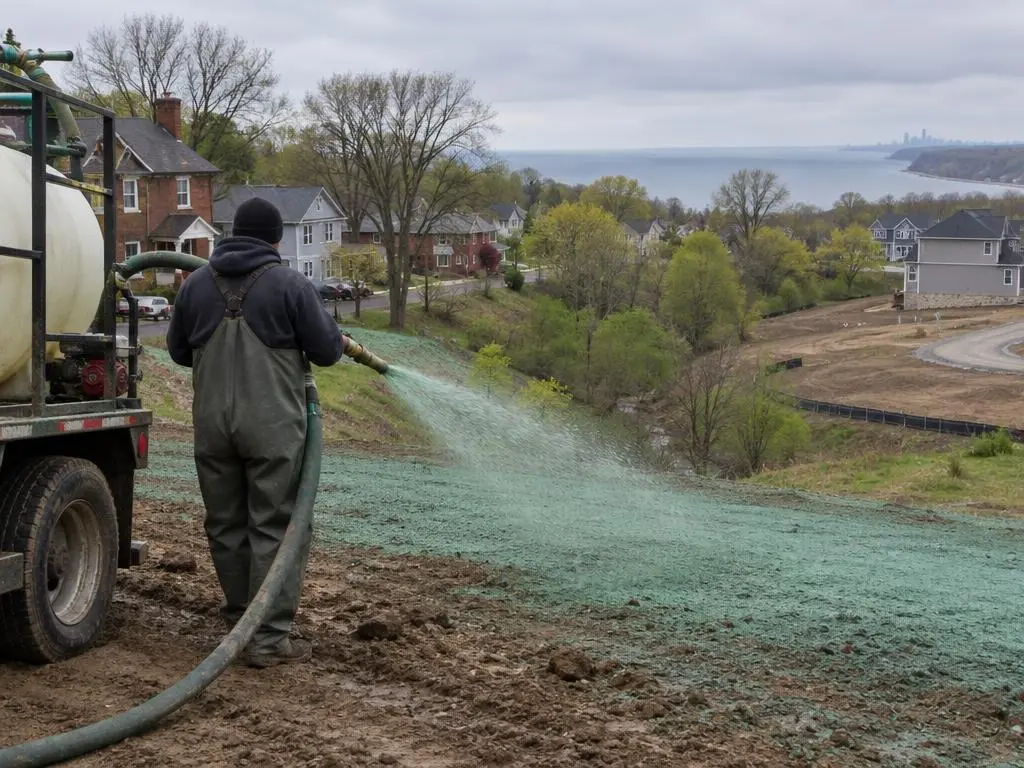
Ravine edges and banks get bonded mulch, blankets or silt fence as the slope calls for, not the same lawn mix as a flat yard.
Seeding on the calendar
We schedule around late-summer and spring windows and tell you plainly when a date is too late for grass to root before frost.
Builder and permit aware
On permitted sites we follow the approved erosion and sediment control plan and work to the inspector's stabilization deadlines.
Book a Free Walk-Through of Your Yard
We look at the grade, soil and slopes, then send a written estimate. Call (216) 820-9857.